School readiness checklist: A practical guide to getting your child ready for kindergarten
Key Takeaways
A school readiness checklist is a guide for noticing useful skills, not a test your child must pass. Readiness develops through ordinary play, conversation, routines, and patient practice.
- School readiness includes social, emotional, physical, communication, and early academic skills.
- Children develop at different rates, so one missed skill does not define their preparedness.
- Everyday routines can build independence with clothing, lunch, belongings, and transitions.
- Visits, clear plans, and useful information can make the first weeks feel steadier.
- Encouragement works better than pressure when you are helping your child prepare.
What school readiness really means
School readiness is broader than knowing letters or counting. It includes the skills that help your child participate in a group, communicate needs, manage small frustrations, and take care of simple tasks. You are looking for a general foundation for learning, not a perfectly polished kindergarten student.
Academic skills versus overall development
Early academic skills matter, but they are only one part of the picture. A child may recognise many letters yet still need support with turn-taking, listening, or separating from a caregiver. Conversely, a child with emerging academic knowledge may be ready to learn because they are curious, communicative, and willing to have a go.
Try to think about the whole child. Can your child listen for a short period, follow a simple instruction, join a group activity, and recover after something goes wrong? Those abilities often make it easier to benefit from classroom teaching.
Why readiness looks different for every child
Some children are confident in groups while others observe quietly before joining in. One child may enjoy drawing and puzzles but find dressing or noisy spaces difficult; another may manage routines well but need more time with speech or early number ideas. These differences are normal and can change quickly with experience.
Use the checklist to spot areas for gentle practice rather than to compare your child with siblings, friends, or children online. Progress matters more than polish, particularly during a major transition.
Age, experience, and learning differences to consider
A child’s age, previous childcare or preschool experience, temperament, language background, and learning profile can all shape how school readiness appears. A child who has spent little time in a group may need practice with shared routines, while a child who learns differently may show understanding in a way that is not immediately obvious.
If a skill is proving unusually difficult or causing your child distress, make a note of what you are seeing. Specific examples are more useful than a broad worry, especially when you speak with educators or a health professional.
When kindergarten expectations vary by school
Schools do not all organise the first year in exactly the same way. Expectations may differ around lunch routines, toileting, uniforms, rest, classroom equipment, drop-off, and how much independent work children do. Local enrolment information and conversations with the school can give you a clearer picture than a general online list.
Ask which skills are genuinely helpful before the first day and which will be taught at school. That distinction can prevent you from turning preparation into a stressful race.
Early academic skills to check
Your child does not need to arrive reading, writing, or completing formal worksheets. It is more useful to notice whether they are interested in language, numbers, books, drawing, and the world around them. Short, playful moments are usually enough to reveal what is familiar and what could use more practice.
Recognizing letters and common sounds
Invite your child to notice letters in their name, on signs, in books, or on familiar packaging. You can talk about the sound at the beginning of a word without turning the conversation into a lesson. If your child guesses or forgets, simply model the answer and move on.
Recognising some familiar letters is a helpful starting point, but it is not a pass-or-fail requirement. Interest in sounds, rhymes, songs, and conversation also supports later literacy.
Counting, numbers, shapes, and simple patterns
Count steps, fruit, toys, or plates as part of normal family life. Ask your child to compare which group has more, notice a circle or rectangle, or continue a simple pattern made with blocks. These small prompts build mathematical language without needing a workbook.
Keep the focus on understanding rather than reciting a long sequence. A child who can count aloud may still be learning that the final number tells how many objects are in a group.
Listening to stories and retelling key details
Read together often, even if the story is short. Pause to ask what happened first, what a character might do next, or which part your child remembers. Retelling can happen through words, drawings, gestures, or pretend play, depending on how your child communicates best.
Listening also includes responding to a question and staying with a shared activity for a little while. If attention wanders, shorten the story and try again another time.
Holding a pencil and using basic classroom tools
Drawing, colouring, painting, cutting with child-safe scissors, using playdough, and building with small blocks all help develop hand control. Your child does not need a perfect pencil grip, and correcting it constantly can take the enjoyment out of practice.
Offer a comfortable range of activities and allow your child to experiment. The aim is to build coordination and confidence with tools, not to produce neat handwriting before school begins.
Social and emotional readiness
Classrooms ask children to manage feelings while learning alongside many other people. Social and emotional readiness involves communication, flexibility, patience, and the ability to accept support. These skills are still developing when children start school, so the goal is not complete self-control.
Separating from caregivers with growing confidence
Separation can feel easy one day and hard the next, especially after illness, holidays, or a change in routine. Practise brief, predictable goodbyes with a trusted adult and explain when you will return using language your child understands. Avoid disappearing without saying goodbye, even when a quick exit seems tempting.
A calm goodbye routine can be repeated at preschool, activities, or visits with family. Your confidence and consistency give your child something familiar to hold on to.
Following directions and managing transitions
School days involve moving from one activity to another, often before a child feels finished. At home, give one or two clear instructions, offer a warning before a change, and use the same phrases for familiar routines. Visual reminders or a simple timer may help some children.
Practise transitions when everyone is reasonably calm. The purpose is to build a habit of listening and moving on, not to test your child under pressure.
Taking turns, sharing, and solving small conflicts
Play gives children a natural way to practise waiting, negotiating, and repairing a disagreement. You might narrate what is happening: “You both want the truck. What could we do?” At first, your child may need several possible solutions before they can suggest one independently.
Role-play can make these conversations easier. Practise asking for a turn, offering an alternative, and getting an adult when a problem feels too big to solve alone.
Naming feelings and asking for help
Your child does not need to stay calm all the time. They do need growing ways to express what is wrong, such as saying “I need help”, pointing, using a feelings chart, or moving to a quiet space. Name the feeling without excusing unsafe behaviour: “You are frustrated, and I will help you keep your hands safe.”
Make asking for help ordinary rather than a sign of failure. Children who can tell an adult what they need are better placed to participate when the classroom feels unfamiliar.
Independence and self-care skills
Small self-care tasks can take longer when a child is learning them, but independence reduces the number of things they must rely on an adult to do at school. Practise at unhurried times rather than during a rushed morning. Step in when needed, then gradually hand the task back.
Using the bathroom independently
Talk with the school about its bathroom arrangements and what support is available. Your child should be working towards managing clothing, wiping, flushing, and handwashing in a way that suits their development. They may still need reminders, particularly when busy or excited.
Practise the full routine at home and make sure your child can communicate that they need to go. If there are ongoing difficulties, share practical information with the school rather than keeping it hidden.
Putting on shoes, coats, and backpacks
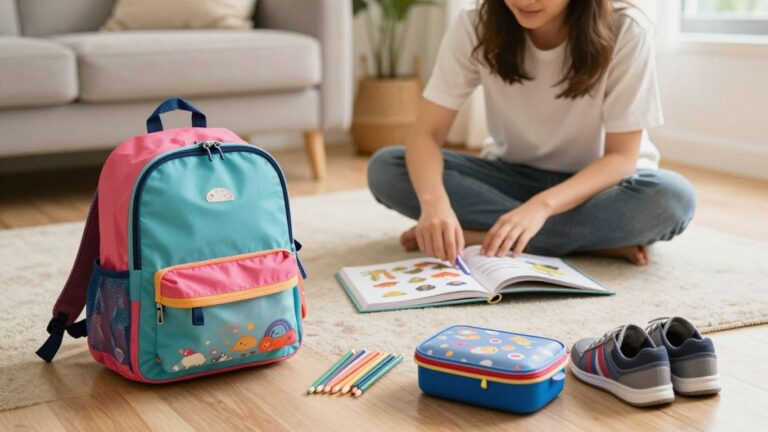
Let your child practise fasteners, sleeves, shoes, and backpack straps when there is no hurry. Elastic laces, simple closures, or a consistent order can make the process more manageable. It is fine to choose practical clothing while these skills are developing.
Praise persistence and let your child solve part of the problem before stepping in. The target is useful independence, not dressing perfectly every time.
Opening lunch containers and cleaning up
Test lunch boxes, drink bottles, wrappers, and containers before the first day. A child can understand what food is available and still struggle with a tight lid or unfamiliar clasp. Practise opening, eating, closing, and packing the items away.
Make cleaning up part of the routine. A simple sequence such as scrape, close, pack, and wipe helps your child know what to do without needing a long explanation.
Keeping track of personal belongings
Children are more likely to manage belongings when each item has a consistent place. Practise putting shoes by the door, hanging a bag on a hook, and checking the floor before leaving. Label clothing and equipment clearly, following the school’s instructions.
You can use a short leaving-the-house check together, but avoid turning it into a scolding ritual. Repetition and calm prompts usually do more than reminders delivered in frustration.
Classroom routines to practice at home
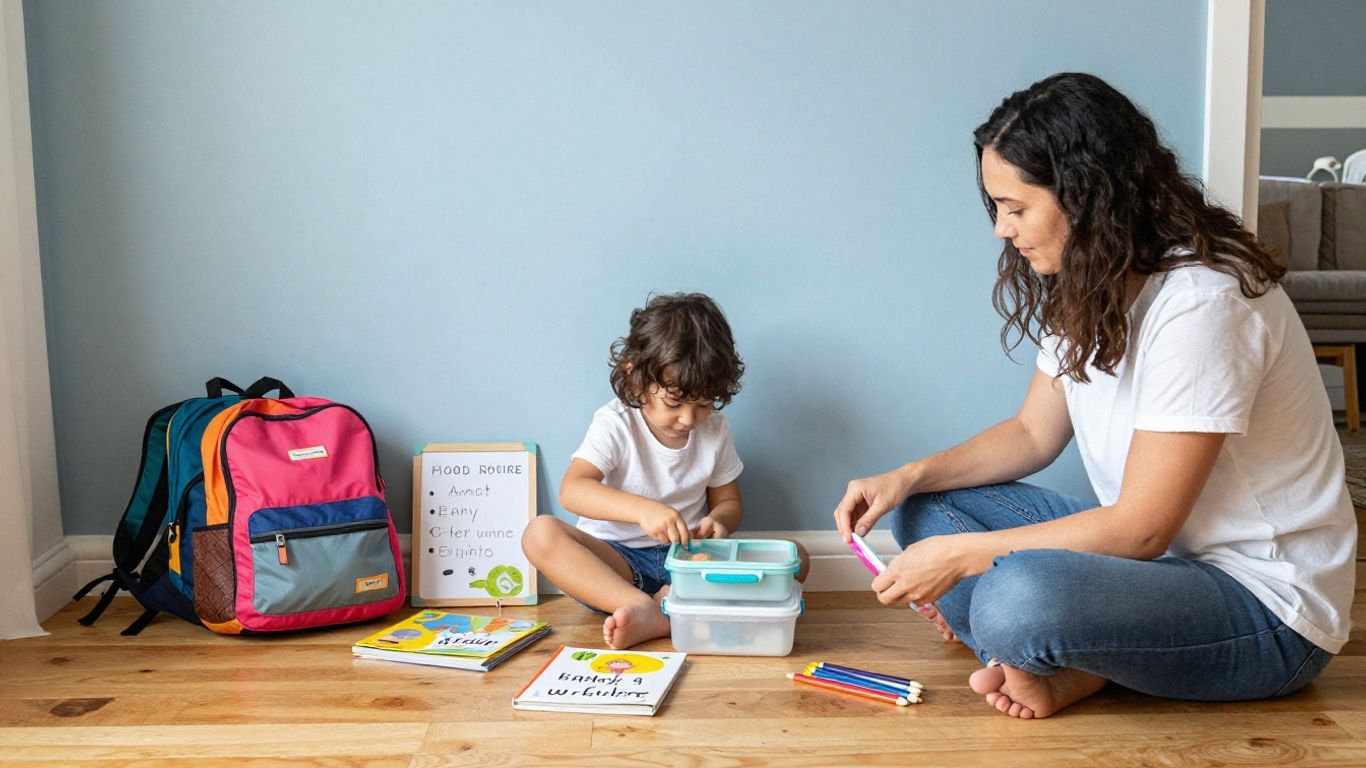
Home practice works best when it resembles real life rather than a miniature classroom. A few repeated routines can help your child know what comes next and give you a chance to notice where support is needed. Keep activities brief enough that your child can finish feeling capable.
Building a consistent morning routine
Work backwards from the time you need to leave and identify the steps that tend to cause trouble. Getting dressed, eating, brushing teeth, packing a bag, and putting on shoes may need different amounts of time. A picture sequence can help a child follow the order without hearing repeated verbal prompts.
Try the routine on several ordinary mornings before school starts. If it falls apart, adjust the routine rather than assuming your child is being difficult.
Practicing focused activities and quiet time
Offer a short activity with a clear beginning and end, such as a puzzle, drawing, looking at books, or building. Gradually allow a little more time, while remembering that young children are not expected to sit still for long stretches. Movement breaks are part of healthy learning.
A quiet period after lunch or in the afternoon can also help your child practise settling. It does not have to mean sleeping; listening to a story or doing a calm activity may be enough.
Getting used to group settings and classroom rules
If possible, include playgroups, library sessions, community activities, or visits with several children. These settings give your child practice listening to another adult, waiting for space, and noticing shared rules. Start with manageable visits and leave before everyone is exhausted.
At home, keep rules few and clear. For example, you might practise walking indoors, using gentle hands, and putting materials away before choosing something new.
Adjusting bedtime, wake-up, and screen habits
A sudden change to sleep and morning times can make the first week harder. Move routines gradually if your current schedule is very different, and protect enough time for a calm breakfast and getting dressed. Screen use may also need a predictable stopping point, rather than an abrupt removal each morning.
A simple evening rhythm helps: pack the bag, choose clothes, wash, read, and settle. The exact routine will vary between families, but predictability is the useful part.
Preparing for a smooth start
Practical preparation can remove small sources of stress when the first days arrive. You do not need to organise every detail months ahead, but it helps to learn the school’s routines and make them familiar at home. Include your child where possible so preparation feels shared rather than mysterious.
Visiting the school and meeting the teacher
Attend an orientation, open afternoon, or other opportunity to see the classroom if one is offered. Point out useful places such as the gate, toilets, office, bag area, and pick-up point. Meeting the teacher can give your child a familiar face to look for.
Keep your language positive but realistic. You can say that school may feel exciting, strange, or tiring, and that adults will help with the parts your child cannot manage yet.
Labeling supplies, clothing, and personal items
Label the items your school asks families to provide, including clothing, hats, drink bottles, and bags. Use labels that are easy for your child and staff to recognise. If there is a uniform, practise wearing it before the first morning so the fabric and fastenings are not a surprise.
Avoid buying extras simply because another family has them. Follow the school list and choose practical items your child can use independently.
Planning lunches, transportation, and drop-off
Decide how your child will travel, who will collect them, and what happens if plans change. Explain the arrangement in simple terms and tell the school who is authorised to collect your child. A practice trip can make the route feel less unfamiliar.
Choose lunches your child knows how to open and eat, while following any school food rules. Keep drop-off brief, warm, and predictable if that suits your child and the school’s guidance.
Sharing important information with the school
Tell the school about information that will help staff support your child, such as communication preferences, allergies already documented with the school, toileting needs, significant worries, or changes at home that may affect the day. Share practical observations rather than a long list of labels.
You can ask how the school prefers families to communicate and who to contact with questions. Early, clear communication gives staff a better chance to respond thoughtfully.
How to use the checklist without adding pressure
A checklist should help you notice patterns and plan small next steps. It should not become a scorecard for your child or a source of daily arguments. Revisit it occasionally, allowing room for growth, tired days, and the fact that children often show skills differently in different settings.
Turning weak spots into everyday practice
Choose one or two areas that would make daily life easier and attach practice to something you already do. Count socks while sorting washing, practise opening a container at lunch, or role-play asking for help during a game. Short repetition is usually more sustainable than a formal practice session.
A useful checklist item should lead to an action you can try, not a judgement about your child. Notice what works and change the activity if it consistently ends in frustration.
Celebrating effort instead of perfect performance
Specific encouragement is more helpful than general praise. Tell your child you noticed that they kept trying, waited for a turn, or asked for help before becoming overwhelmed. You can celebrate improvement even when the task is not yet independent.
Keep comparisons out of the conversation. Your child is preparing for their own first year, not competing for a readiness ranking.
Knowing when to ask a teacher or pediatrician for guidance
Speak with the school if you are unsure what will be expected or if a particular difficulty may affect your child’s participation. A paediatrician or other qualified health professional may also help you decide whether a concern deserves further assessment. You do not need to wait until the first day if worry is persistent.
Bring concrete examples: what happened, how often, what helped, and where the skill was easier or harder. This makes the conversation more useful and avoids jumping to conclusions.
Updating the checklist during the first weeks of school
The first weeks provide new information. Your child may manage a task at home but need reminders in a busy classroom, or they may surprise you by handling something independently. Add notes about what the teacher observes and which routines are settling.
Use that information to adjust support, not to reopen every item as a problem. Readiness continues to grow after the first day, through relationships, practice, and ordinary classroom experience.
Conclusion
Preparing for kindergarten is less about completing every item and more about giving your child familiar routines, encouraging relationships, and confidence to keep learning. Use this school readiness checklist as a flexible conversation starter, practise through everyday life, and remember that asking for support is part of preparing well.
Frequently Asked Questions
What is included in a school readiness checklist?
It usually covers early communication and academic skills, social and emotional development, physical coordination, self-care, routines, and the ability to participate in a group. The exact items vary between children and schools.
Does my child need to read before starting kindergarten?
No. Familiarity with books, language, sounds, and some letters can help, but formal reading is not the only measure of readiness. Curiosity, listening, communication, and willingness to learn also matter.
How can I help my child separate at drop-off?
Create a short, predictable goodbye routine, explain when you will return, and stay calm and clear. Practise brief separations beforehand, and ask the school for guidance if drop-off remains very difficult.
What self-care skills should a child practise before school?
Practise using the bathroom, washing hands, managing clothing and shoes, opening lunch containers, packing belongings, and asking for help. Your child may still need reminders while adjusting to a busy setting.
How long should home practice sessions be?
There is no single ideal length. A few minutes woven into play, meals, dressing, or outings can be more effective than long sessions that leave everyone frustrated. Stop while the activity is still manageable.
What if my child is behind in one area?
Focus on one practical skill at a time and look for playful ways to practise it. Share your observations with the school, and seek guidance from a paediatrician or another qualified professional if the concern persists or affects daily life.
Can a child be ready for school but still feel nervous?
Yes. Nervousness is a normal response to a new environment and does not automatically mean a child is unprepared. Familiar routines, supportive adults, and time to settle can help confidence grow after school begins.